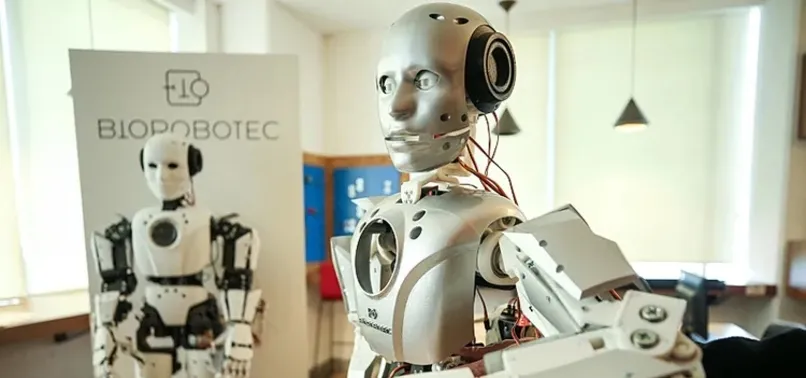
The Turkish Industry and Technology Ministry on Monday launched a call for proposals on the development of humanoid robots for industrial applications to develop homegrown humanoid robots that outperform rivals.
The program targets bipedal robots made for manufacturing assembly, logistics, and precision machining.
The program aims to curb reliance on imported subcomponents while cultivating a skilled workforce and fostering high-value-added ecosystems in robot-as-a-service, edge computing, and physical artificial intelligence.
Funding for the program covers the entire process, including the design, prototyping, testing, validation, and real-world deployment.
The program prioritizes the homegrown development of software architecture, sensors, control and motion systems, torque-controlled actuators, harmonic reducers, servo motors, robotic grippers, autonomous, decision-making modules, and navigation software.
Each AI-powered bipedal robot is required to stand at least 1.6 meters (5.25 feet) tall, operate for at least four hours amid mixed tasks, be able to carry at least 15 kilograms (33 pounds) per arm, and lift at least 35 kg (77 lbs.) with both arms from waist height, according to the call's minimum technical standards.
The Turkish robots will be designed to surpass global counterparts in lifting capacity — with most leading competitors limited to payloads of up to 25 kg (55 lbs.) — and in endurance, speed, and navigation.
Further technical requirements include a continuous flat-ground walking speed of at least 1.4 meters (4.6 ft) per second, a running speed of at least 2.2 meters (7.2 feet) per second, and the ability to climb steps of at least 20 centimeters (7.9 inches), and operation on slopes of at least 25 degrees.
AI software will help robots with environmental awareness, task planning, human-robot interaction, image processing, sensor data fusion, autonomous motion, peripheral vision, 3D obstacle detection, and tactile sensing.
As for power specifications, the call requires hot-swappable batteries in no more than three minutes without interrupting operations and a recharging capability from 20% to 80% in 30 minutes or less.
The call also requires Technology Readiness Levels (TRL) of three to five to at least TRL 8 compliance to ensure safety and quality, alongside other strict requirements.
The call offers a 50% grant on eligible costs for projects of up to 48-month duration with applications evaluated on innovation, research and development (R&D) merit, economic value, competence, budget realism, sustainability, and social impact, with no budget cap.
Applications can be made through rip.sanayi.gov.tr through Dec. 31.


