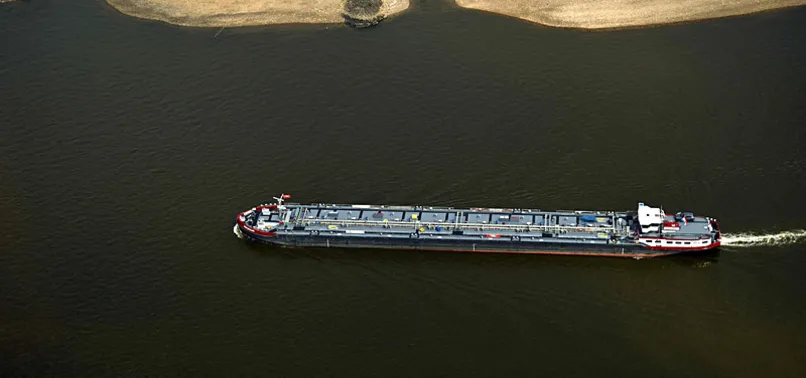
Water levels on the Rhine River, one of Europe's busiest shipping arteries, have fallen to another low, official data showed on Tuesday, hampering transport and production.
The water level gauge at the chokepoint of Kaub near the city of Koblenz fell to 0 cm late on Monday, inland navigation agency WSV data showed, before rising back to 5 cm early on Tuesday.
A spokesperson for the agency said last week that the records being set in September had yet to be verified, but that "unaudited raw data suggest that historical records are being broken."
The riverbed is more than 1 metre deeper than the gauge, which has been traditionally used to measure local levels.
Low water levels on the Rhine have become a burden for Germany's economy, particularly its chemicals sector, by restricting barge traffic for companies like BASF, Bayer or Covestro.
If the Kaub gauge falls below 78 cm for 30 straight days, as was the case in 2022 and 2018, German industrial production typically falls by about 1%, according to economic institute IfW.
However, the broader German economy has so far proved more resilient than expected, with growth forecasts revised higher and business sentiment improving despite elevated energy prices and logistical bottlenecks.
"The low water levels are unlikely to be a one-off phenomenon," said RWI chief economist Torsten Schmidt, adding that climate change raised a fundamental question about whether production sites would have to be relocated from along the river.
"That is the more important question for the economic outlook," he said.


